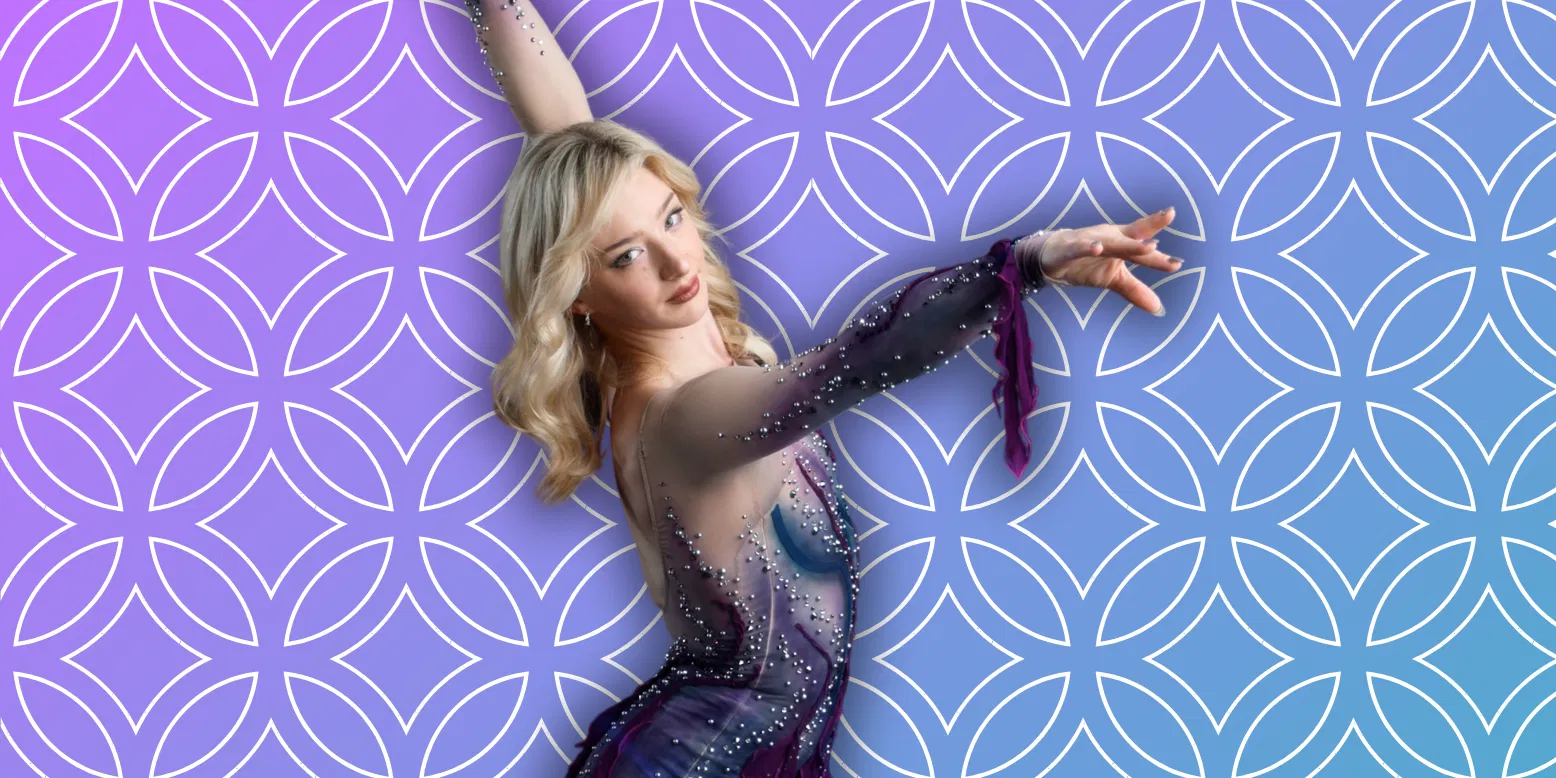
Amber Glenn, two-time national figure skating champion — and the first out queer woman to win these titles — answers our Zoom call in a grey zip-up, her blonde hair tied up and a Pikachu doll in the back corner of her screen.
We chit-chat for a while about the implications of being queer women growing up in the South, her in Texas and me in Tennessee. The 25-year-old athlete tells me that she identifies with bisexual and pansexual, but sometimes, the labels get to be too strict. She’s a figure skater, first and foremost, and her sexuality is flexible.
Over the next hour, Glenn and I talk about her experiences growing up in the figure skating world, the unfair and hypocritical ideals placed on young girls, and her mental and physical health journeys. Overall, it was a fantastic yap session about gender norms and mental health in sports between two Gen Z-ers. What more could you ask for?
However, one thing that became clear to me over the course of that Saturday evening is the complexities behind Glenn’s identities and her dreams for the sport. Glenn aims to leave the skating world better than she found it, encouraging young people to take part in the sport that has given her — and cost her — so much. Furthermore, she has no plans of leaving the ice anytime soon, whether that means competing, teaching, or simply creating art.
While Glenn may be known as the “first out queer woman” to win a national championship — not to mention the possible Olympic appearance in her future — she is much more than just her sexuality.
How was coming out as queer informed by your figure skating journey? How did this all start for you?
I remember seeing the movie Burlesque when I was young, and I was just way more attracted to Christina Aguilera than to the male lead. And I was like, “Something’s happening. Something’s taking place.” When I was younger, I knew something was up.
When I was struggling with my mental health, I ended up seeing a doctor somewhere. We were filling out a checklist. One of the questions was about sexual identity, and I remember getting to that question. It was just me and the nurse, and I was like, “Actually, I always felt that I wasn’t 100% straight, but I don’t know what to check on that.” And she’s like, “That doesn’t matter. We’re not dealing with that today. We’re dealing with your mental health.” Okay, message received. I remember feeling so shut down by that.
I didn’t really think about it for too long, because I was always skating. But then one of my training mates, Timothy Leduc — they are the first nonbinary winter Olympian — really opened me up to the knowledge of the community, especially in Dallas, and was always someone I could talk to about how I was feeling, what I was thinking, and really inspired me with their own journey. They really helped me try and understand myself. Seeing them live their truth was just really inspiring. And at that point, friends and family kind of knew.
And eventually, a queer magazine in Dallas was writing an article on Leduc, and I was mentioned in passing as someone who’s also in the queer community or something like that. And I was like, “Okay, there’s my little baby step out of the closet publicly,” and then, the next day I wake up and there’s articles everywhere about me coming out. I was like, “Oh my god.” The first thing in my mind is like, “I don’t know if I told my grandma!”
Being able to feel like I’m completely me, I felt like I was able to explore and express myself on the ice, and it wasn’t as limited. I never felt like I fit 100% into the femininity that I saw from some of these athletes. The only one I could look back at was someone like Tonya Harding, but that doesn’t exactly have great associations. I didn’t want to feel like I had to do exactly what everyone else did.
Were judging scores a concern for you when you came out?
It was something I was nervous about. Over the years, we see judges that we know and have met at events, but we don’t know all of them, especially at international events. I have no idea what their political opinions are. It could be offensive to them. If a judge just had a problem with queer people, I’d say, “Screw that judge. That’s not a me problem. That’s a you problem. You need to fix your mind.” But I was still nervous about the preconceived notion that queer women are less feminine or less graceful, or not able to be the ideal skater, because I’m not like a princess that needs to be saved. So that was something that plagued my mind a bit, but I decided that this meant more to me than any scores could.
How does it feel to kind of have the responsibility of being a role model to young queer women?
It’s something that I thought about when I came out, and I hoped that it would be something that would help inspire other people. But the next competition I went to, I had people coming up to me talking about their journeys and about how me identifying as queer publicly and competing on the biggest stage in the country made them feel more comfortable in their communities, in their training environments, even within their own families. Over the years, it has been so fulfilling to see the encouragement from me being myself — not just my results, but who I am.
The first year I won Nationals, I didn’t even think, I just grabbed the Pride flag, which stirred up some controversy. So, I grabbed it, and I’m like, “Hell yeah, like a queer woman just won Nationals. Let’s go!” I’m showing that you can be yourself and not have to fear that you can’t be successful in your field.
There’s been so much support that outweighs any sort of negativity, and I’m so grateful for that, and I’m grateful for the people around me for encouraging me to be myself.
Mental health is an important part of your platform. How does that intersect with both figure skating and your queer identity?
From a young age, I was at the top. I was going to national ranking competitions at 8 years old. I always worked really hard, really pushed myself. And then when I got older, around puberty, I started really struggling. I was growing. A lot of times, for women in figure skating, they want you to stay as small as possible, both in height and in weight. I’m growing and things are changing, and things are getting harder. Now, looking back, that’s normal: I was a child growing up, I had to adjust to my body. But it was just so stressful, and I eventually started struggling with my eating and with my body image, and eventually with anxiety and depression.
I remember being 12 years old, told to wear all black so I can look sleek and slim. I was always told to be mature, be mature, be mature. I had to grow up so early. It’s like they want you to be mature, but also the size of a child.
Even back then, one of my coaches was just, “Oh, you should try this diet.” I was 12. It was like, “Try this fat burning pill.” Excuse me?! I was small. I was growing. Jeez, God forbid.
I felt like I needed to be slim, not that I needed to be healthy. So I was doing it in a way that was so unhealthy. I know that I’m an athlete and that there is a certain level of physical health that I need to have in order to have success, but I would lose weight by starving myself and then eating a sh*t-ton of candy or desserts and then starving myself. And that is, again, not sustainable.
Now, I know I need to be in a certain physical shape so I can do what I want to do, not because I need to look a certain way. Then, it wasn’t just I needed to lose weight so I can do my jumps. No, I needed to lose weight so I could look the part.
It’s something that’s so different in figure skating — how aesthetics do play a part in it, unfortunately. It was all-consuming at the time, especially when you’re a teenage girl. It’s just so toxic.
Then, I started doing really well in competitions. It was a short-lived period of me doing well, because I was doing things the wrong way, which gets quick results but ends up exploding eventually. I won my first big competition when I was nearly 14, and I was struggling. I had disordered eating and my emotions were all over the place. I couldn’t sustain how I was living. My mental health got worse, everything was just spiraling into a perfect storm, and eventually I just cracked. I was lucky enough that one of my close friends noticed and told one of my parents.
At the time, the environment I was in was really toxic. My mental health didn’t matter, what mattered was my results. I was 15 at the time. So eventually I just get to the point to where I’m just broken. And that’s when I eventually try and confide in the nurse about my identity, while also tackling the topic of my mental health, and it was kind of shut down.
Eventually I started medication, I started managing my anxiety and depression, and it gets better. And I think the last piece of the puzzle was when I came out. Until then, I was kind of struggling with who I was and what I was doing and where I belonged, and being able to come out just took that weight off my shoulders. I feel like that really did help improve my mental health and my own perception of myself, and it’s a never-ending journey.
Mental health is not fixed. You have it forever; it’s a winding road. And I’ve made so much progress, and I really am open about it, because I was struggling so bad at that young age. It just encouraged me to try and find a healthier way to try to find success in my sport and set up the next generation to avoid some of the mistakes that I made. Of course, no one’s journey is perfect, but if I can help people avoid those issues, then I’m happy. I’ve done what I want to do in the sport, regardless of results.
Do you think that this focus on sustainability in your sport has contributed to you being an athlete far past the age when many people retire?
For sure. I got to see behind the curtain of the older generation of skaters. At the beginning, I was trying to be like them at any cost, and it was unsustainable. And turns out it wasn’t really for them either. For that generation, as soon as they were done skating, they got the hell out of the sport and didn’t want anything to do with it. It was just so tense. So now I’ve tried to kind of change that perspective, and I think that’s not just from me, but from time and today’s culture and community.
A lot has changed in women’s figure skating, and I’m really happy about it, because I’m seeing that younger generation encouraging those younger than them. And I don’t think I’m the only one in the sport that has had that type of impact.
Okay, so what are the next steps in your career? What are you thinking over the next year?
My season just concluded. I actually leaving Tuesday for my first USA Stars On Ice tour, which was a dream of mine growing up. Oh my god. It’s gonna be so exhausting, but so exciting. I’m bringing little stickers, because it’s kids, but it’s also just people that are skating fans. I want people to feel more included. If I’d have gotten a sticker from a skater back when I was younger, it probably would have gone on the car window of my mom’s minivan, but I would have cherished it. So I think just something so small as that, and being able to encourage the new generation.
After that, pre-Olympic season starts. It’s game time. Time to start preparing things. Get ready. So I’ll compete this season normally, which is Grand Prix in the late fall, and then Nationals. And how my season goes determines Olympics. So my entire year factors into it, but Nationals is the last competition before the Olympics. So, you know, fingers crossed. Hope everything’s good, that I stay healthy, I stay in a good mental and physical space. And I really do believe that as long as I do that, I can be in Milan with some people that I have been training with for years, that I have gotten to know and that I call my friends. So obviously that is a huge goal.
Back in 2020, I didn’t know if I was going to continue skating or not. I decided that if I do, I really want to challenge myself. And the goals I made were to land a triple axel — which was very exciting when I did that — and to go to the Olympics. After that, who knows where things will take me. I could keep skating. I could do another season just for fun, and challenge myself and just creatively and athletically see what happens. I could go on to just tours and shows and teach and do seminars.
No matter what, I want to stay in the skating world, because I really do love it. I love watching it. I love teaching it. I love doing it. It is my passion, for sure, and I really want to continue to try and make it a better, safer space for young athletes, so they can have all of the enjoyment of figure skating without some of the toxicity that has been lingering in the sport for many decades.
What do you want your legacy to be?
I want to be known as someone that helped diversify the sport, that encouraged inclusivity regardless of gender, race, sexuality, identity. That’s what I want, is to just try and make it a more enjoyable experience for people in the future of figure skating and show that someone who didn’t necessarily fit the mold of a typical figure skater was able to find their voice and find their passion, and despite certain things trying to keep me keep me down, I was able to move past them and be stronger.
Read more at INTO Magazine here.